


How I Write

Ah, the process of writing. Just have an idea, sit by the computer, and let the idea come out onto the page. That’s it. Nothing else. You can move on now. That is my whole process, so this is a nice short blog.
Wait. You are still here? What? You think there is more to it than just that?
Well, I see you are not going to leave until I tell you my process. Fine. I guess I will tell you.
Call me old-fashioned, but I like to write using a pen and paper. The ideas flow better for me when doing it this way. There is something very powerful about using a pen.
In a world dominated by keyboards, screens, and technology, putting pen to paper to create a story feels uniquely powerful. Writing by hand forces me to slow down and gives my thoughts and imagination time to develop naturally instead of racing to keep up with my typing. Every word becomes more deliberate, giving me time to explore ideas, develop characters, and sometimes discover directions I didn't expect.
Unlike a computer, where distractions are only a click away, a notebook gives me a quiet, personal space where I can just write. No email. No notifications. No sudden urge to look something up that somehow turns into twenty minutes of doing everything except writing.
There is also something deeply personal about the physical act of writing. The movement of the pen across the page creates a connection between my thoughts and the words I put down. Crossed-out sentences, scribbled notes, arrows, and ideas squeezed into the margins all become part of the process.
A computer encourages me to constantly edit and perfect things, sometimes before an idea has even had the chance to fully develop. Pen and paper let me be messy. I can make mistakes, chase bad ideas, find better ones, and let the story go somewhere I did not expect.
Maybe that is the biggest advantage of writing by hand. A blank page does not care about grammar, formatting, margins, or whether the first draft is any good. It just wants me to write.
There is no blinking cursor reminding me that I am stuck, no notifications competing for my attention, and no temptation to immediately rewrite every sentence because I suddenly decided one word sounds stupid.
Computers are invaluable when it comes to editing and preparing a finished manuscript, but for me, the best part of the story usually begins with a notebook, a pen, and permission to let my imagination run wild.
Well, publishing my handwritten work would not work very well.
I mean, I can barely read my own chicken scratch, so expecting other people to read it is probably a bit of a stretch. Obviously, there are going to be a few more steps.
So, what is the next step?
I am so glad you asked.
Next, I scan everything into the computer. Since I have two monitors, I put the scanned image on one monitor, open a new Word document on the other, and start typing away.
This is where something interesting happens. I am not really just copying what I wrote by hand. As I type, new ideas come to me. I change wording, strengthen scenes, add details, and sometimes realize something I wrote in the notebook can be better. In a way, typing the handwritten draft becomes my first rewrite.

That second pass really adds to the story, in my opinion.
Once I finish typing, I use Grammarly to help catch mistakes.

I know it is hard to believe, but yes, even the great Jason Cross can have typos.
And they are only typos, because I do not make any actual mistakes.
Ever.
Okay, moving on.
Once I am happy with what I typed, I move on to the next step. I run the chapter through ChatGPT to have it proofread and ask for suggestions on ways to make the chapter stronger without changing the story or my voice.
I think it is important to say that ChatGPT (and other AI programs) should be used only as a tool. I highly suggest that you never use these programs to write for you. Use it only as a tool to help with your writing, not to do the actual writing.
I do not accept every suggestion. Some are pretty solid, I have to admit. Others do not fit the chapter, do not sound like me, or conflict with something I know is going to happen later in the story.
That is an important part of the process for me. ChatGPT can make suggestions, but I still decide what belongs in my story.
I ask ChatGPT to create two files for me. One is strictly the proofread version. The second includes the suggested changes. Then I use Word’s Compare feature to look at the two versions side by side and decide which changes actually help.

These are the two prompts I normally use:
“Can you please proofread this while keeping my voice? Please suggest ways to strengthen the story without changing it.”
Then:
“Can you create two downloadable files? One should be just the proofread version, and the second should include your suggested changes. I want to compare the two.”
I run every chapter through this process until I have completed the entire book.
Then I do it again.
Yes. The whole thing.
Once I finish the second pass, I combine the proofread versions of every chapter into one manuscript. I set the page size to 6 x 9 inches, use Garamond at 11-point font, and format each chapter title using a heading style so I can create a table of contents.
Then I upload the book to Amazon, set everything up, and order a physical proof.
Once the proof arrives, I read through the entire book one last time. When you have the actual book in your hand, it is much easier to see what ideas work and won’t. For me, that is much easier than reading it off the computer.

Because apparently, after writing the book, typing the book, proofreading the book twice, formatting the book, and staring at the book for months, I still do not trust myself.
After that final read-through, I am finally ready to set a publication date.
Well, that is it.
My whole process.
I am not saying this is the best way to write a novel. It is simply the process that works for me.
And so far, it has worked pretty damn well for Ironport.
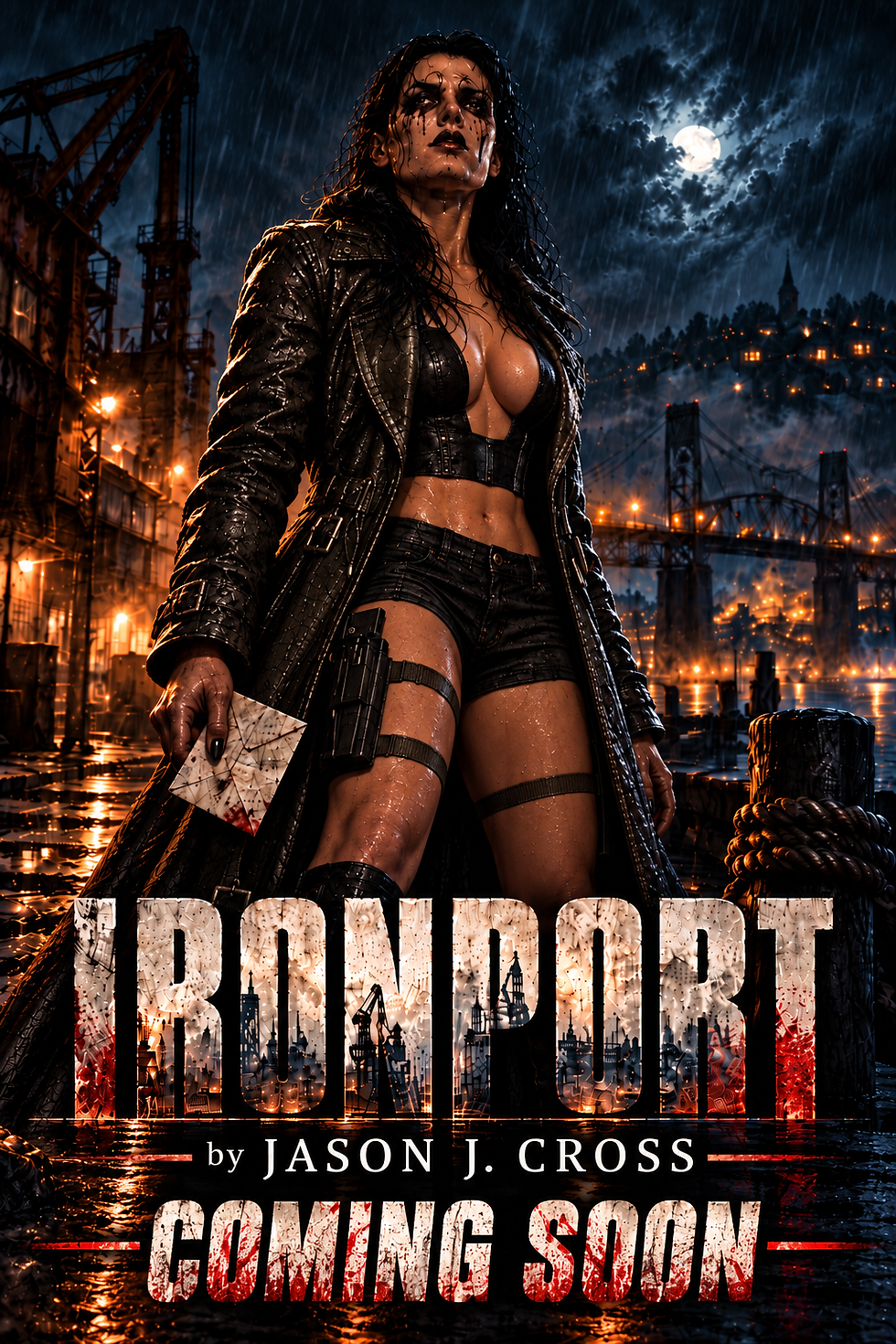
IRONPORT — Coming Soon.


Comments