


When Superheroes Become Monsters: Is Horror Taking Over Comic Books?
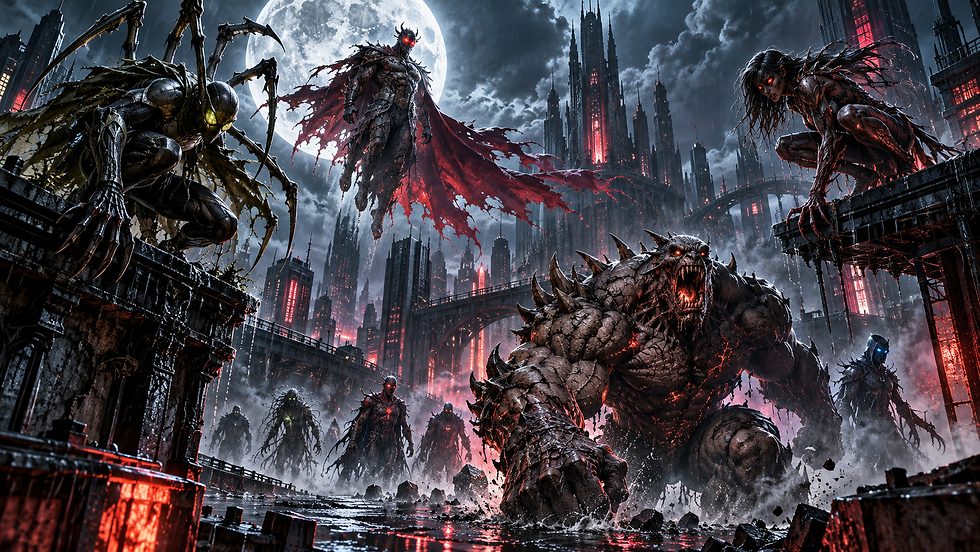
Spider-Man is supposed to swing through New York saving people.
The X-Men are supposed to protect a world that fears them.
The Fantastic Four are explorers, adventurers and superheroes.
But what happens when Spider-Man becomes the monster?
What happens when the X-Men stop worrying about humans fearing mutants because they're too busy fighting vampires?
What happens when the Fantastic Four's journey into the unknown stops being an adventure and becomes cosmic horror?
Apparently, we are about to find out.
And Marvel isn't the only publisher moving deeper into the darkness.
Something interesting is happening in comic books right now. Horror isn't merely sitting beside superheroes on the shelf anymore.
It's infecting them.
Welcome to the Midnight Universe
On October 7, 2026, Marvel Comics launched its new Midnight Universe, an interconnected line devoted to horror-infused versions of some of the company's biggest characters.
Marvel made an unusual commitment to the launch: Midnight Spider-Man #1, Midnight Fantastic Four #1 and Midnight X-Men #1 were the only Marvel comics released that day. AIPT
That's a lot of confidence to place behind three horror comics.
And these aren't simply Halloween specials where Spider-Man fights Dracula before everything returns to normal next month.
Marvel describes Midnight as a separate, creator-driven universe built specifically around horror.
In Midnight Spider-Man, Peter Parker's familiar spider powers become considerably more disturbing. The heroic fantasy of having the abilities of a spider suddenly moves much closer to the horrifying possibility of becoming one.
Midnight Fantastic Four pushes Marvel's famous explorers toward cosmic horror.
And Midnight X-Men places mutants inside a New York divided between mutant and vampire populations, with ordinary humans potentially trapped between them. ComicBook.com
The concept is simple.
Take characters audiences already know.
Then ask:
What if everything wonderful about them became terrifying?
Apparently, Readers Were Interested
Before the books even reached comic shops, Marvel announced that the three first issues had collectively exceeded one million retailer orders.
All three went back to press before their October 7 release, with second printings scheduled for October 28. AIPT
There's an important distinction here.
One million retailer orders doesn't necessarily mean one million individual customers purchased copies. Comic stores place those orders based on anticipated demand, variants, collectors and other market considerations.
But it still sends a message.
Retailers believed people wanted this.
Marvel clearly believed it too.
The publisher didn't bury Midnight inside the October catalog. It essentially gave horror the entire Marvel stage for one Wednesday.
Then IDW Went Even Further
If Marvel's Midnight Universe were the only example, this could easily be dismissed as another major publisher experimenting with an alternate universe.
Then came IDW Goes Dark.
On October 5, just two days before Marvel's Midnight launch, IDW revealed plans to expand its IDW Dark horror imprint throughout 2027.
And the characters being pulled into horror make Marvel's experiment look almost predictable.
Teenage Mutant Ninja Turtles.
Sonic the Hedgehog.
Star Trek.
Godzilla.
Even Hello Kitty is included in the initiative alongside original horror properties and established franchises such as A Quiet Place and The Twilight Zone. Graphic Policy
Yes.
Hello Kitty.
Horror has apparently reached the point where no fictional universe is completely safe.
And that's actually what makes this development fascinating.
Horror Doesn't Need Horror Characters Anymore
There was a time when putting horror into a comic meant using a horror character.
Dracula.
Werewolves.
Ghosts.
Demons.
Swamp creatures.
Marvel itself has a long history with characters such as Werewolf by Night, Man-Thing, Blade and Ghost Rider. Horror and superheroes have never truly been strangers. How To Love Comics
But something has changed.
Publishers increasingly don't need a traditional horror character.
They can turn the existing character into the horror.
And superheroes are almost perfectly designed for it.
Consider Spider-Man without thinking about decades of colorful costumes, jokes and heroic adventures.
A teenager is bitten by a genetically altered spider.
His body changes.
He becomes stronger.
He begins sticking to walls.
His senses mutate.
Eventually, he produces abilities associated with an arachnid predator.
That's already disturbingly close to body horror.
We simply accepted the superhero version first.
Most Superpowers Are Horrifying If You Think About Them Long Enough
Comic books usually present transformation as empowerment.
Horror asks what that transformation would actually feel like.
Imagine discovering that your body regenerates every time you're injured.
Wonderful.
Now imagine experiencing every injury before it heals.
Imagine waking up one morning and discovering that your skin has become rock.
Imagine hearing every thought around you and being unable to turn the voices off.
Imagine suddenly discovering that sunlight burns your skin.
Or that something inside you takes control whenever you're angry.
Or that every night your body physically transforms into something else.
Change the perspective slightly and the origin of a superhero starts sounding suspiciously like the beginning of a horror story.
That's where these genres fit together so naturally.
Superhero fiction asks, "What could I become?"
Horror asks, "What am I becoming?"
Sometimes those are the same question.
Horror Has Already Been Sneaking Into Comics
Marvel Midnight didn't arrive in a vacuum.
One of the biggest modern horror-comic success stories is James Tynion IV and Werther Dell'Edera's Something Is Killing the Children.
What began as a planned five-issue series grew into a much larger mythology now commonly called the Slaughterverse, encompassing the main comic, spinoffs and expanded storytelling. It has also moved toward film and television development. EW.com
Meanwhile, Publishers Weekly reported earlier this year that publishers of manga, manhwa and related comics were significantly increasing their investment in horror.
One publishing editor summarized the shift very simply:
“Horror has become mainstream.”
The article pointed to expanding horror lines, genre hybrids and growing audience demand rather than one narrow type of horror dominating the market. PublishersWeekly.com
And look at the shelves this month.
FANGORIA's October roundup identified 26 new horror comics, ranging from original properties to established horror icons and monstrous reinventions of superheroes. Fangoria
That's no longer a tiny corner of comic publishing.
Why Horror Works So Well With Familiar Characters
There's another reason publishers may be interested in this combination.
Horror becomes especially effective when it corrupts something familiar.
We know what Spider-Man looks like.
We know what he's supposed to do.
We know what he represents.
So seeing that familiar silhouette transformed into something predatory creates an immediate reaction.
The audience doesn't need twenty pages explaining why something is wrong.
We already know what “right” looks like.
That allows writers to play with expectations.
Superman represents hope.
What happens when hope becomes frightening?
Batman deliberately frightens criminals.
What happens when he becomes genuinely monstrous?
The Hulk has always existed on the border between superhero story and monster movie.
The Fantastic Four gained their powers through a scientific catastrophe.
The X-Men's abilities emerge through genetic mutation.
Push any of those ideas slightly further and suddenly we're standing firmly inside horror.
The Monster Is More Interesting When We Care About the Human
There may also be a deeper reason audiences respond to superhero horror.
The best monsters aren't simply monsters.
They're tragedies.
The werewolf is frightening because there is still a human being trapped inside.
Dracula is fascinating because immortality hasn't necessarily saved him.
Frankenstein's creature is powerful because the monster is capable of understanding what has happened to him.
That same conflict works beautifully with superheroes.
Peter Parker becoming physically monstrous matters because we know Peter Parker.
We know the person inside the creature.
The question isn't simply:
Can someone kill the monster?
It becomes:
Can the hero survive becoming one?
That's a much more emotionally complicated story.
Comics May Be the Perfect Place for Horror to Experiment
There's also something comic books can do that movies sometimes can't.
They can go completely insane.
A filmmaker imagining a city-sized creature has to consider budgets, sets, visual effects and production schedules.
An artist needs another page.
That freedom makes comics particularly suitable for surreal creatures, impossible architecture, grotesque transformations and enormous supernatural events.
FANGORIA recently made essentially the same observation when discussing the current horror-comics crop: comics aren't restricted by the production budgets imposed on other visual media, allowing creators to be exceptionally imaginative with their horror. Fangoria
For horror, that's dangerous territory.
In the best possible way.
So, Is Horror Taking Over Comic Books?
Not exactly.
Batman probably isn't going to become a flesh-eating monster in every issue.
Spider-Man isn't permanently abandoning superhero stories.
And colorful adventures aren't disappearing.
But something more interesting may be occurring.
Horror is becoming less of a separate genre and more of a storytelling language.
Publishers can apply it to superheroes.
Science fiction.
Fantasy.
Licensed characters.
Comedy.
Children's icons.
Manga.
Established movie franchises.
Original independent comics.
That may be the real trend.
Horror doesn't need its own corner anymore.
It can walk into someone else's universe and change the rules.
Marvel handing an entire release day to the Midnight Universe would already have been noteworthy.
IDW announcing horror versions of properties ranging from Teenage Mutant Ninja Turtles to Hello Kitty makes it much harder to dismiss as coincidence.
And the continued growth of independent horror comics suggests publishers aren't merely experimenting because Halloween is approaching.
They're following readers.
Maybe Superheroes Were Monsters All Along
Perhaps horror and superheroes were never as different as they appeared.
Both genres revolve around transformation.
Both deal with extraordinary bodies.
Both create impossible creatures.
Both ask what happens when ordinary rules stop working.
The difference is often what happens after the transformation.
In superhero stories, the character looks into the mirror and discovers something extraordinary.
In horror, they look into the mirror...
…and realize something is wrong.
Comic publishers appear increasingly interested in removing that boundary.
Which leaves us with one final question.
If superheroes can become monsters...
who should horror infect next?
What Do You Think?
Would you read a horror version of your favorite superhero?
And more importantly:
Which normally non-horror comic character would become absolutely terrifying if someone treated their powers realistically?
Let us know.


Comments