


Horror Is Breaking Box-Office Records—But Are Audiences Finally Ready for the Next Great Monster?
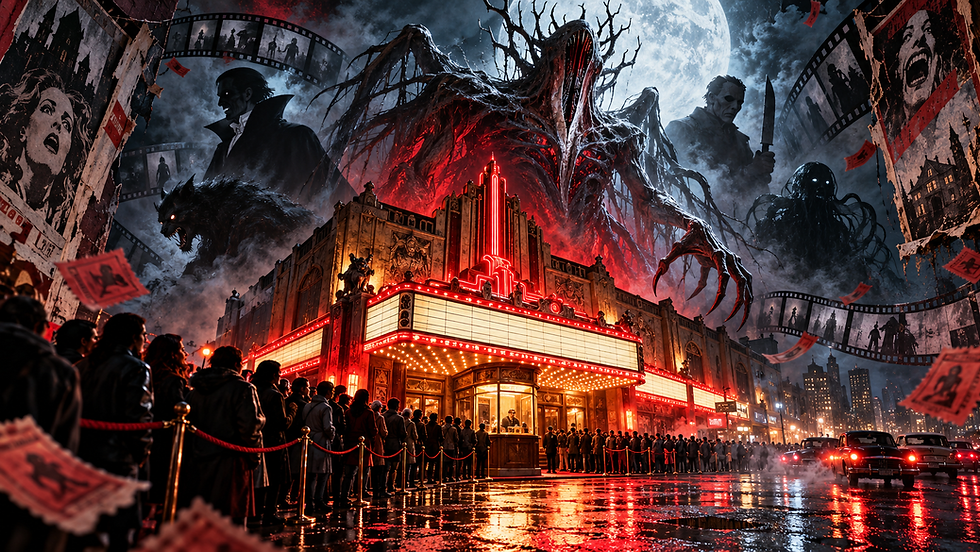
For decades, Hollywood has operated under a fairly safe rule when it comes to horror:
If the monster works, bring it back.
Freddy returned.
Jason returned.
Michael Myers returned.
Ghostface returned.
The Xenomorph returned.
Predator returned.
And if enough years passed without another sequel, Hollywood simply started everything over again.
There is nothing necessarily wrong with that. Horror fans love their icons. These characters survived because something about them connected with audiences.
But eventually, someone has to ask the uncomfortable question:
Where is the next one?
Where is the monster that audiences haven't already known for thirty or forty years?
Because something happening at the box office in 2026 suggests horror fans may finally be ready to meet it.
Horror Isn't Just Successful Right Now. It's Huge.
As of October 13, 2026, horror movies have generated roughly $1.28 billion at the domestic box office.
That puts the genre only about $150 million away from setting a new annual record, with more than two months still remaining in the year. Horror or horror-comedy films have already claimed the No. 1 position at the domestic box office six times this year. Barron's
Those aren't numbers from a genre surviving in the shadows.
That's a genre becoming one of Hollywood's most reliable businesses.
And the latest movie to reach No. 1 didn't have Freddy Krueger, Ghostface or another decades-old horror icon attached to it.
It had Other Mommy.
Meet Other Mommy
Other Mommy, director Rob Savage's adaptation of Josh Malerman's novel Incidents Around the House, opened on October 9.
The story follows eight-year-old Bela and a sinister entity lurking inside her home.
The creature calls itself Other Mommy.
It can resemble Bela's mother.
It manipulates her.
It wants Bela to allow it inside.
And while the movie arrived with overwhelmingly negative reviews and received a brutal D+ CinemaScore from audiences, something interesting happened.
People still showed up.
The movie opened at No. 1 with approximately $27.8 million domestically and roughly $45.7 million worldwide against a production budget reported around $19 million. AP News
Whether Other Mommy ultimately becomes a beloved horror movie is another question.
But its opening proves something important.
Audiences didn't need decades of nostalgia to convince them to meet this particular monster.
They came anyway.
And Other Mommy isn't the most convincing evidence.
Not even close.
Then There Was Obsession
Earlier this year, something happened that should make anyone creating original horror pay attention.
A young filmmaker named Curry Barker made a supernatural horror movie called Obsession.
Not Halloween 14.
Not another Texas Chainsaw Massacre.
Not a reboot of a famous monster.
An original screenplay about a young man who uses a mysterious object called the One Wish Willow to make the woman he loves fall for him.
Naturally, because this is horror, getting exactly what he wants turns out to be a terrible idea.
The production budget was approximately $1 million or less.
Its eventual worldwide box-office total?
More than $520 million. The Numbers
Read those numbers again.
Around a million dollars.
More than half a billion in ticket sales.
Even stranger, Obsession didn't explode and disappear.
It grew.
Its first domestic weekend brought in about $17.2 million.
The second jumped to nearly $24 million.
The third climbed again to more than $27 million.
That kind of growth is extremely unusual for a wide-release horror film, which normally makes its biggest splash opening weekend and then drops quickly. The Numbers
People weren't simply seeing Obsession because advertising told them to.
People were apparently telling other people to see it.
That's how monsters used to become legends.
Then Backrooms Opened the Door
Two weeks after Obsession arrived, another strange horror property hit theaters.
Backrooms.
Anyone following internet horror probably already knew what that meant.
Endless yellow hallways.
Buzzing fluorescent lights.
Dirty carpeting.
Rooms that shouldn't exist.
And the unsettling feeling that something may be wandering those hallways with you.
The Backrooms began as an internet phenomenon and was later transformed into an extraordinarily popular YouTube horror series by filmmaker Kane Parsons.
Hollywood eventually gave Parsons the feature.
When it opened on May 29, Backrooms earned approximately $81.4 million domestically in its first weekend.
A24 had never seen anything like it.
Its previous biggest opening belonged to Civil War at $25.5 million.
Backrooms more than tripled that.
The movie eventually reached roughly $400 million worldwide on a reported $10 million production budget. TheWrap
And suddenly one of 2026's biggest horror threats wasn't a killer in a mask.
It wasn't a vampire.
It wasn't a zombie.
It wasn't even necessarily a conventional monster.
It was a place.
That's where things get interesting.
Maybe Audiences Aren't Looking for Another Freddy
Whenever horror fans discuss the "next great monster," we tend to picture another humanoid villain.
A mask.
A weapon.
A recognizable silhouette.
Something that eventually becomes a Halloween costume.
But perhaps we're asking the wrong question.
Maybe the next great horror icon won't resemble Freddy, Jason or Michael at all.
Consider what younger horror audiences are already embracing.
The Backrooms.
Siren Head.
SCP creatures.
Analog-horror entities.
Mimics.
Doppelgängers.
Impossible spaces.
Things discovered through corrupted video footage.
Creatures that don't necessarily have an official explanation.
That's very different from the horror icons created during the 1970s and '80s.
And that might be exactly why it works.
We Already Know Too Much About the Old Monsters
Suppose Dracula walks into a horror story.
Before he says anything, you probably know quite a bit.
Blood.
Fangs.
Sunlight.
Stakes.
Maybe garlic.
Now put a werewolf into the story.
Full moon.
Silver.
Transformation.
Zombie?
Destroy the brain.
We know the rules because popular culture spent decades teaching them to us.
That familiarity is part of their appeal.
But it can also work against horror.
Because fear thrives on uncertainty.
Now imagine encountering something called Other Mommy standing inside your child's bedroom.
What does it want?
What can it do?
Can it be killed?
Should you speak to it?
Can you trust what you're seeing?
You don't know.
And not knowing may be one of horror's most powerful weapons.
The New Monsters Don't Come With Instruction Manuals
That's one reason internet horror has become so interesting.
It often refuses to explain itself.
You see an image.
You hear a story.
You watch strange recovered footage.
Something appears in the background.
Then audiences begin trying to figure out what they're looking at.
The mystery becomes part of the entertainment.
Hollywood appears to have noticed.
The massive success of Backrooms and Obsession has already increased industry interest in internet-born horror and younger creators. At BlumFest in October, Blumhouse and Atomic Monster showcased several upcoming projects tied to digital creators and online horror properties. Vulture
That creates an unusual moment for horror.
Instead of studios deciding what monster audiences should like, audiences may increasingly make that decision before Hollywood ever arrives.
But Franchises Aren't Going Anywhere
None of this means audiences suddenly stopped loving familiar monsters.
Far from it.
Resident Evil has also been a major theatrical success this year, with the latest film passing $320 million worldwide by October. Scream 7 was another No. 1 horror release. Barron's
Legacy franchises remain powerful.
Probably because they offer something original monsters can't:
certainty.
When you buy a ticket for Scream, you know roughly what experience you're getting.
Original horror asks audiences to gamble.
Maybe the monster works.
Maybe the premise works.
Maybe the movie is frightening.
Maybe it's terrible.
But 2026 increasingly suggests people are willing to take that gamble.
And that's important.
Because horror cannot survive entirely by resurrecting the past.
Eventually, every generation deserves monsters of its own.
Horror Has Always Needed New Blood
Think about how ridiculous some of horror's greatest ideas might have sounded before they worked.
A burned child murderer kills teenagers inside their dreams.
A silent man wearing a cheap mask walks around suburban Illinois killing babysitters.
An unstoppable killer wearing a hockey mask stalks campers.
A creature bursts from someone's chest aboard a spaceship.
A videotape kills you seven days after you watch it.
A shark terrorizes a beach town.
None of those concepts became iconic because audiences were already familiar with them.
Someone took a chance.
Then audiences responded.
Eventually the strange new monster became the familiar old monster.
That's the cycle horror needs to continue.
And perhaps 2026 is showing studios they can afford to take that chance again.
Money Changes Everything
There is another reason horror may become increasingly welcoming to original monsters.
The economics make sense.
Consider the contrast.
Backrooms: about a $10 million production budget and roughly $400 million worldwide. The Numbers
Obsession: around $1 million or less and roughly $520 million worldwide. The Numbers
Other Mommy: roughly $19 million and more than $45 million during its opening worldwide. AP News
Those numbers explain why studios keep returning to horror.
A superhero movie can cost hundreds of millions of dollars before marketing.
Horror can succeed with a hallway.
A mask.
A strange tree.
A disturbing voice.
A creature glimpsed for three seconds behind someone.
The idea matters more than the budget.
That makes horror one of the few remaining theatrical genres where somebody with a genuinely strange idea can potentially compete with franchises costing ten or twenty times as much.
So Where Is the Next Great Monster?
Maybe that's the exciting part.
We don't know.
It could emerge from a novel.
It could appear in an independent comic.
It could come from folklore that mainstream audiences have never encountered.
It could begin inside a $10 indie game.
Someone could upload it to YouTube.
Someone could post a strange photograph on Reddit tonight.
Or some unknown writer could be creating it right now.
What 2026 increasingly demonstrates is that audiences aren't automatically rejecting horror because they don't recognize the name.
Obsession didn't require forty years of sequels.
Backrooms didn't need an established Hollywood franchise.
Other Mommy didn't need audiences to already recognize its creature.
People were willing to enter the theater and discover something new.
That may be the most encouraging horror trend of all.
Maybe Horror Doesn't Need Another Resurrection
Hollywood will keep resurrecting its monsters.
Michael will return.
Ghostface will return.
Predators will hunt again.
Someone will find another reason to open the gates of Hell.
And we'll probably watch them.
But somewhere between all those sequels, reboots and legacy franchises, something else appears to be happening.
Audiences are leaving room for strangers.
New ideas.
New nightmares.
New rules.
New creatures.
And if horror really is approaching the biggest box-office year in its history, perhaps Hollywood finally has less reason to ask:
"Which old monster can we bring back?"
And more reason to ask:
"What haven't audiences seen yet?"
Because Freddy Krueger was new once.
So was Jason.
So was Michael Myers.
So was the Xenomorph.
Every great horror icon had a moment when audiences encountered it for the first time.
Maybe somewhere out there, another monster is waiting for that moment.
And for the first time in a long time...
the audience might actually be ready for it.
What Do You Think?
Horror is having an extraordinary year, but which direction should the genre take next?
Do you want more movies featuring familiar icons—or would you rather meet something completely new?
And the bigger question:
What does the next great horror monster need to become as recognizable as Freddy, Jason or Dracula?
Let us know.
Sources
Barron's reports that horror has earned roughly $1.28 billion domestically in 2026 and is closing in on an annual genre record. Barron's Read the report
The Associated Press reported Other Mommy's No. 1 opening and approximately $45.2 million global debut. AP News AP's box-office coverage
Box-office data for Obsession shows an original screenplay produced for around $1 million ultimately reaching approximately $520 million worldwide. The Numbers Obsession box-office data
Backrooms reached approximately $400 million worldwide after an $81.4 million domestic opening on a reported $10 million production budget. The Numbers Backrooms box-office data


Comments